
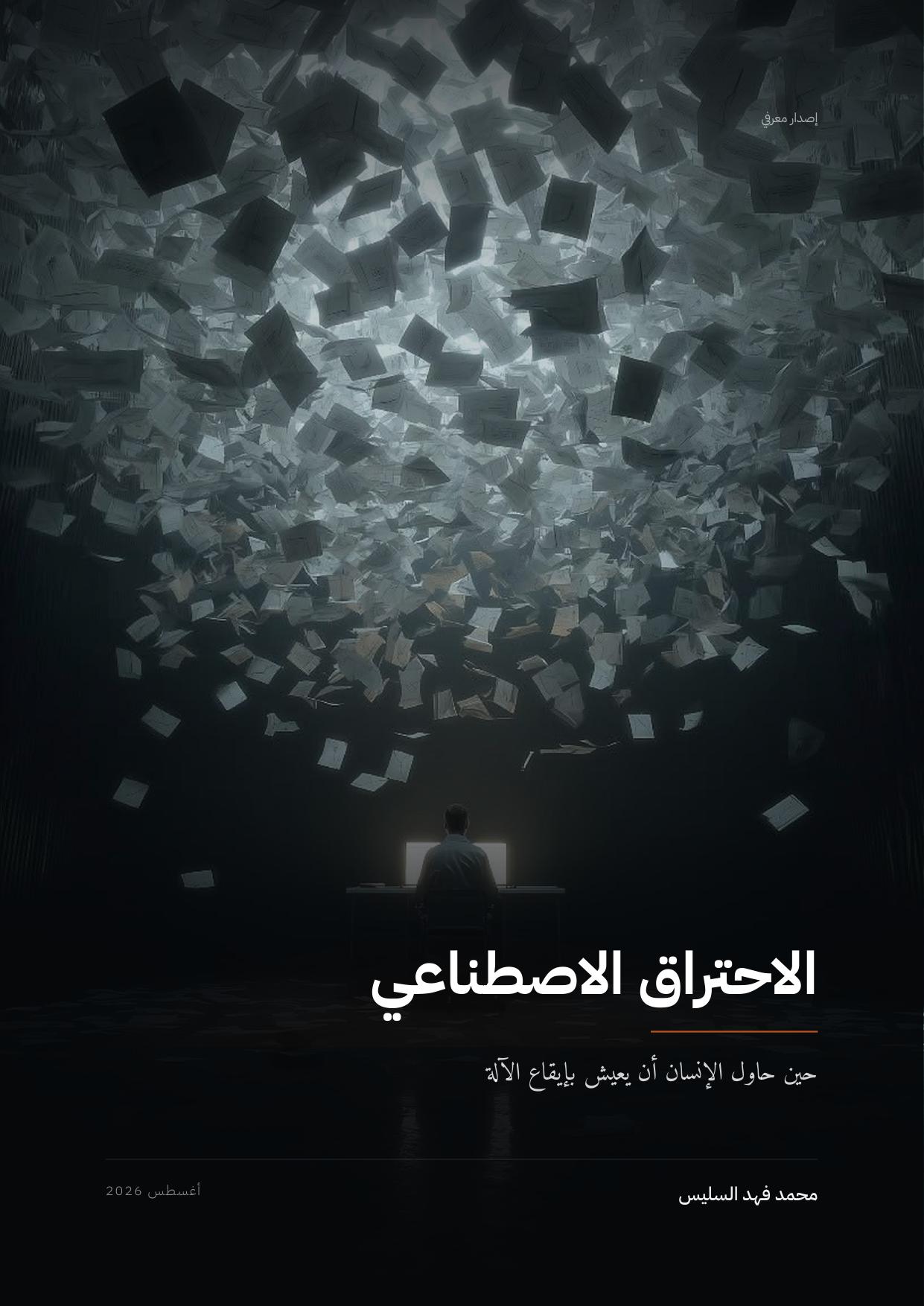
Knowledge Publication · August 2026
An analytical reading of artificial burnout: how time saved by AI is instantly reinvested into new work, draining judgment, attention and verification — and how to reclaim human pace and sovereignty.
About This Publication
An independent knowledge publication (August 2026 · Riyadh) in four parts and twelve chapters, reading a contemporary phenomenon: our machine-augmented capacity now advances faster than our ability to absorb, review and take responsibility for what we produce. Its opening observation is almost irritatingly simple — saved time never returns to us; it is immediately reinvested in new work, and as the ceiling of the possible rises, the ceiling of the expected quietly rises with it.
This is not a complaint about artificial intelligence. The tools do exactly what was promised: they compress time, lower cost and raise the quality floor. What drains us is not volume of work alone, but the erosion of judgment, attention and verification — and of the ability to say “enough” in an environment that never stops. The machine does not tire, sleep or feel satiated; we do.
The publication moves through eight positions between promise and sovereignty: fascination, acceleration, abundance, dependence, saturation, burnout, recovery, sovereignty. Part one explains how the promise of time became pressure; part two traces the road to depletion; part three examines what reliance on AI does to our minds and voices; part four is devoted entirely to recovery — what to automate, what to augment, and what to keep for ourselves.
Throughout, it explicitly separates research evidence, market observation, analytical inference and terms coined inside the work. It closes with a charter for the relationship with intelligence, a sovereignty framework across eleven assessment dimensions, and a conclusion titled: the human is not a slow machine.
Key Themes
- 01Part One · The promise that changed everything: when the machine promised us time
- 02The artificial productivity paradox and non-human speed
- 03Part Two · The road to burnout: an abundance we cannot absorb
- 04The human became the bottleneck, and decision burnout
- 05Part Three · What intelligence does to our minds: thinking debt
- 06Tool anxiety, and when everyone starts to sound alike
- 07Part Four · Reclaiming control: not everything automatable should be automated
- 08Working at human pace, human sovereignty, and an eleven-dimension sovereignty framework
Key Insights
- Saved time never returns to us; it is immediately reinvested into new work.
- As the ceiling of the possible rises, the ceiling of the expected quietly rises with it.
- The new depletion is not from workload, but from the erosion of judgment, attention and verification.
- The machine never tires, sleeps or feels satiated; measuring yourself by its pace is borrowing from yourself.
- Feeling fast is not evidence of being fast.
- The better the model gets, the heavier verification becomes — not the lighter.
- Taste and context cannot be generated; they are what remains human.
- Homogeneity is a commercial risk, not an aesthetic one: when everyone sounds alike, voices lose value.
- The goal is not withdrawing from technology, but redefining the human's position within it.
- The human is not a slow machine.
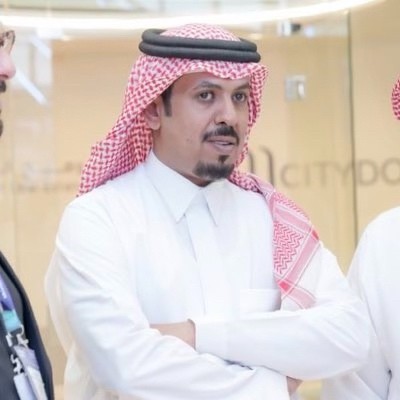
About Mohammed
Board Member & Head of Sales and Marketing Sector at Waheej Real Estate, working across marketing and sales leadership, investment and opportunity assessment, product development, pricing, feasibility and market research — pairing executive governance with market insight, Artificial Intelligence and PropTech.
Riyadh, Saudi Arabia